
Happy Monday Morning!
Asking rents in Canada fell again in December, falling for the 15th consecutive month according to Rentals.ca. Furthermore, December marked the slowest month for rental demand in two years, capping off five straight months of declining prospect counts.
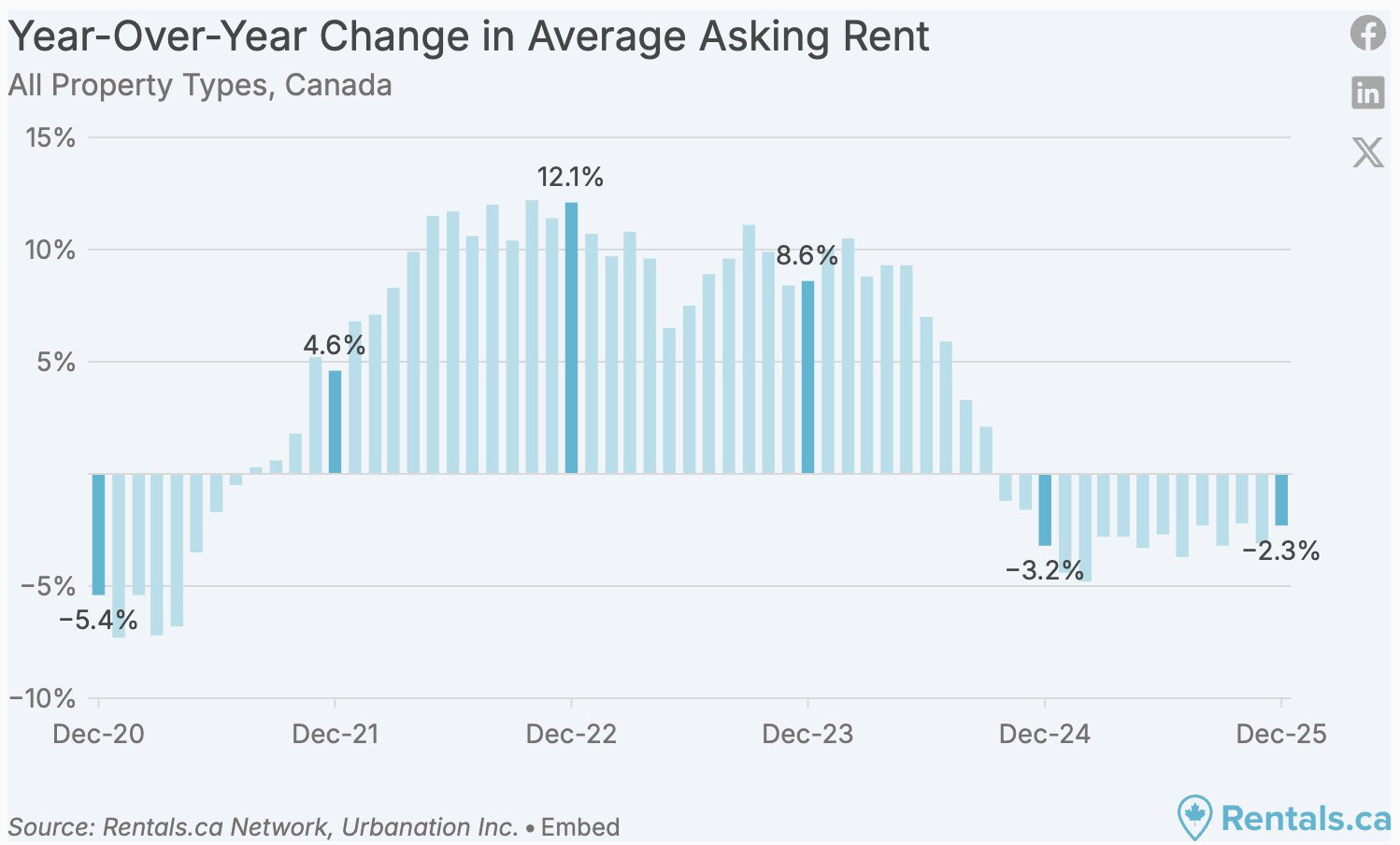
For those that have been following this newsletter, falling rents will come as no surprise. However, the extent of the decline is certainly eye opening. Vancouver and Toronto apartment rents have now plunged to levels last seen in early 2022, recording two-year drops of 13.3% and 11.8%, respectively.

From our perspective, the data provided by Rentals.ca is the most accurate, real time data we have seen. It’s certainly much better than CMHC which mostly tracks turnover rents. Either way you slice it, the recent figures provided by Rentals.ca coincide with various other data points we have flagged before. For example, the CMHC shows the vacancy rate in Vancouver has now surged to a thirty year high.
There’s an abundance of new rental supply flooding the market, with developers having to offer several months of free rent and other perks to get these buildings leased up.
As the always insightful Ben Rabidoux notes,
“Canada's population through the first 3 quarters of 2025 grew by a whopping 1,000 people. That's TOTAL population growth including permanent and temp residents. Over the last 3 quarters, nearly 100,000 rental units have started across the country.”
Developers are still ramming through rental supply despite the rental market deteriorating at a rapid pace, almost entirely because of CMHC’s rental construction program requiring very little equity while handing out jumbo 50 year amortizations.
This is morphing into a real problem, and is actually exacerbating the downturn in the resale market. Let me explain.
For years prices increased, rents increased, and population expanded. This drove more investors into the housing market, chasing ever higher returns and supercharging demand. These conditions are all reversing. In fact, the national home price index has now declined nearly 22% from the peak, the sharpest correction in several decades.
According to BMO,
“While real estate prices are positive, keep in mind that inflation over that period has run at 3.7% annualized, leaving real home prices contracting. In fact, in real terms, home prices are now roughly unchanged from where they were 9 years ago.”
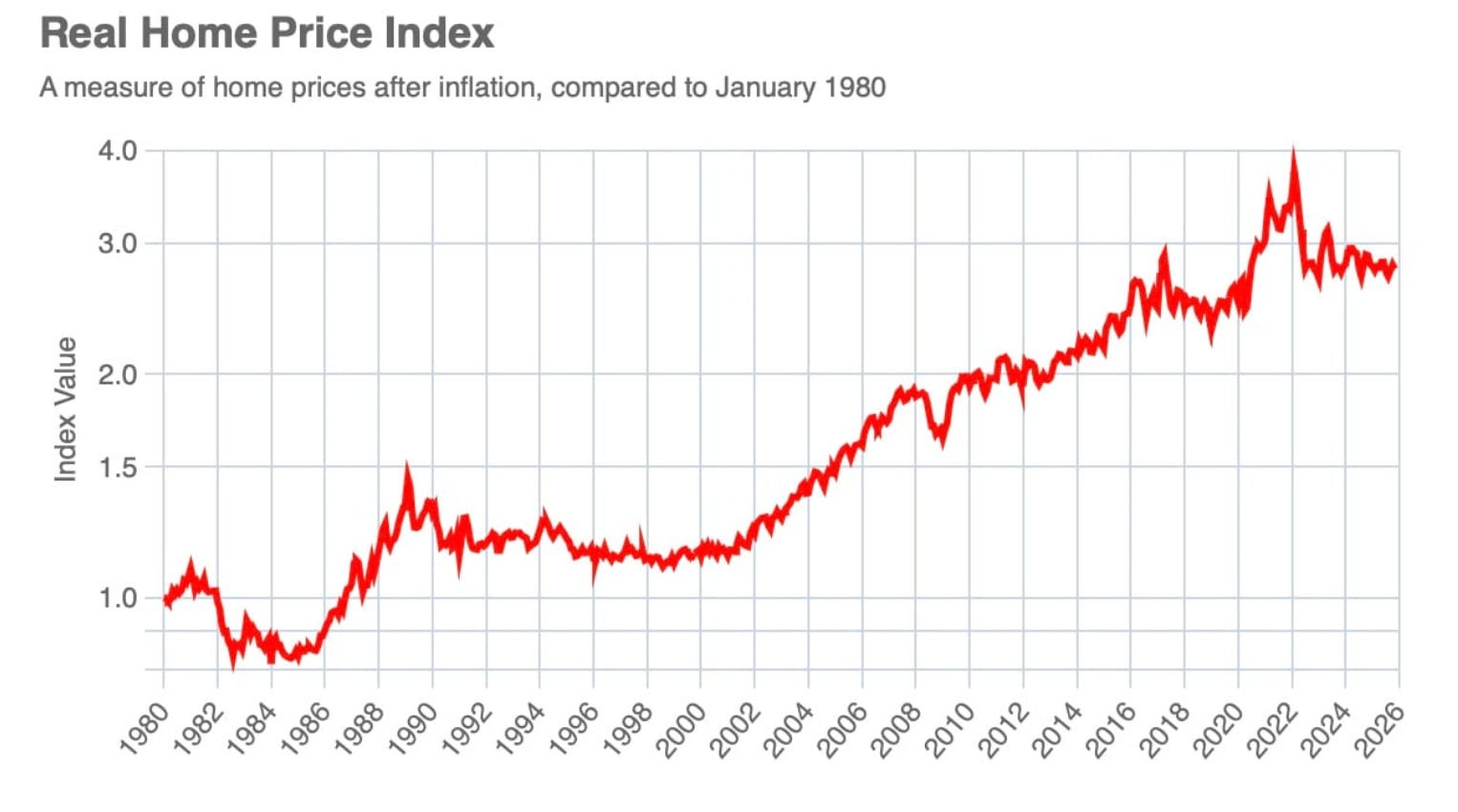
The prospect of higher returns has vaporized, so capital is looking for a new home. Investors are mostly gone, crushing the demand curve. Hence the 25 year low in home sales last year in both Vancouver and Toronto.
As a result, developers have stopped selling pre-sales and have shifted to building rentals. Yet, ironically, as more rentals flood the market, they’re driving investor cash flows lower, and delaying the inevitable return of the pre-sale buyer.
I can tell you in my Real Estate business, we are getting an increasing number of investors calling with rental properties that are suddenly vacant and having to make the difficult decision of either selling at unfavorable prices, or grinding it out in the rental market with longer lease up periods, and lower rents.
For example, we had one investor client reach out in April 2023 about selling their rental condo downtown. At the time we gave them a valuation of $625,000. They decided not to sell, and kept it rented. Fast forward today, the tenant has now moved out, so they asked for an updated valuation. Today it’s $525,000. Nearly three years and a $100K lower.
They might be better off renting it out today, but they’ll have to accept a lower rent. For some sellers thats fine, for others who are already negative cash flow, that’s a problem.
The point being, in 2022 and 2023 when the resale market was soft, at least rents were still moving higher. This gave sellers an option. If they didn’t like the valuation or the offer price they could just rent out the unit and wait.
You can see this in the new listings count. In 2023 we had a 20 year low in new listings for the year! Why sell in a soft market when rents are so good and the housing market will surely bounce back any day.
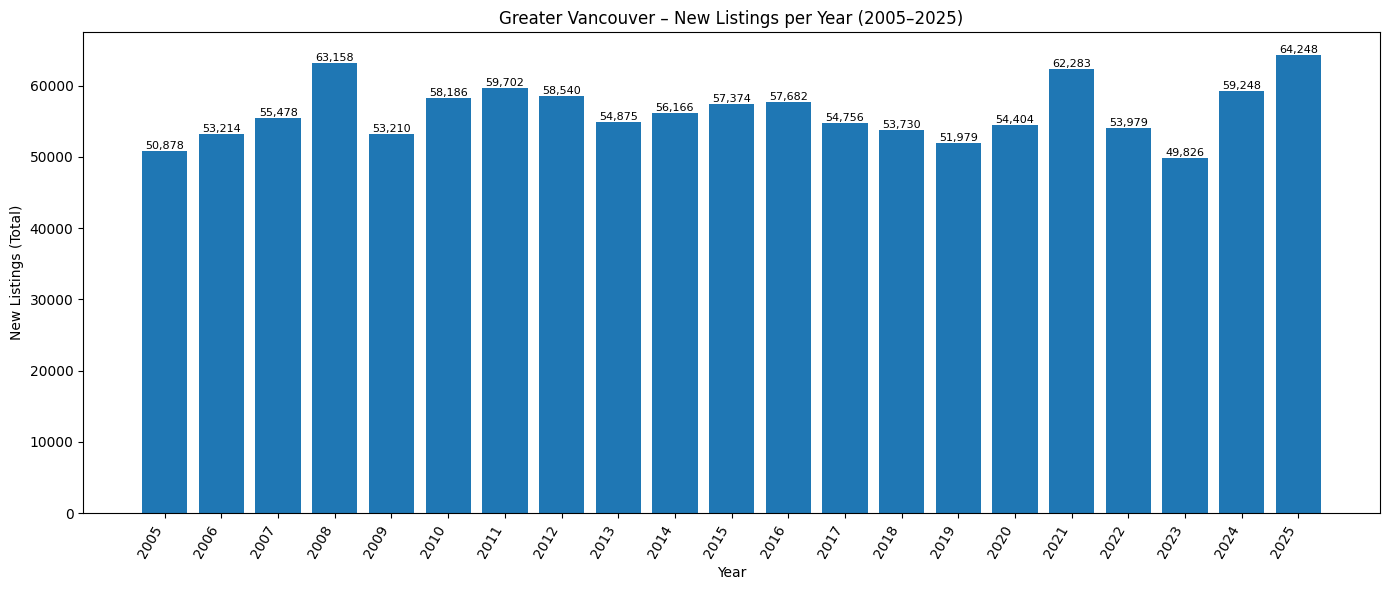
That optimism is now fading as we enter year five of the correction. I suspect we will see another big year for new listings with a lot of sellers that tried to sell in 2025 but were unsuccessful, combined with a weakening rental market that makes Plan B (renting it out) less of an option.
Let’s watch.
"This is morphing into a real problem, and is actually exacerbating the downturn in the resale market."
It's certainly bad news for investors and landlords, who face the prospect of ever-increasing competition from the wave of new rental supply. But it's good news for renters and first-time homebuyers.
I enjoy reading Steve's weekly report although I don't live in BC now and have recommended friends to subscribe. I question one point regarding that Canada's population for the first 3 quarters 2025 increased by a mere 1,000: that didn't seem right and researched-
No, Canada's population growth was not a mere 1,000 people in the first three quarters of 2025; instead, it saw very slow growth in Q1 (around 20,000) but a significant decrease in Q3 (76,000), primarily due to falling non-permanent residents, leading to a total slowdown, though not just 1,000 people overall for the nine months, with Q2 showing modest gains. The figure "1,000 people" mentioned in a January 2026 blog post refers to total population growth over the last three quarters (Q1-Q3 2025) as a massive understatement or specific data point within broader trends, but official StatCan data shows numbers in the tens of thousands.