
Happy Monday Morning!
It’s a big week for central bank watchers and debt holders alike. The CPI report for the month of April drops tomorrow, it’s the last CPI before the Bank of Canada meets on June 05. Markets are currently pricing in just shy of 50% odds that Tiff cuts in June. It’s a coin toss, but either way Tiff will have a difficult decision to make.

Highly levered households are in desperate need of a rate cut but it looks increasingly likely our neighbours to the south aren’t moving to cut rates anytime soon. So will the Canadian dollar be the sacrificial lamb? It’s already down nearly 3% against the dollar this year.
"As a rule of thumb, a 10% fall in the loonie would boost core goods prices by 2.5%," noted Olivia Cross, economist at Capital Economics. Further noting that core goods make up about 30% of the Canadian CPI basket.
The interest rate gap has stayed within 100 basis points since the global financial crisis of 2008-09. Still, that level may not be a binding constraint if the Canadian outlook deteriorates over the second half of 2024, notes Robert Both, a senior macro strategist at TD Securities.

Suffice to say there’s a lot riding on this CPI print on Tuesday. Many sellers we chat with today are holding their breath, delaying price cuts in hopes that this summer will bring rate cuts and renewed optimism for the housing market. After all, housing slumps are always short lived in Canada, right?
As my friend Ben Rabidoux notes, this is already a historic housing downturn in Canada. Unless you live in Calgary.
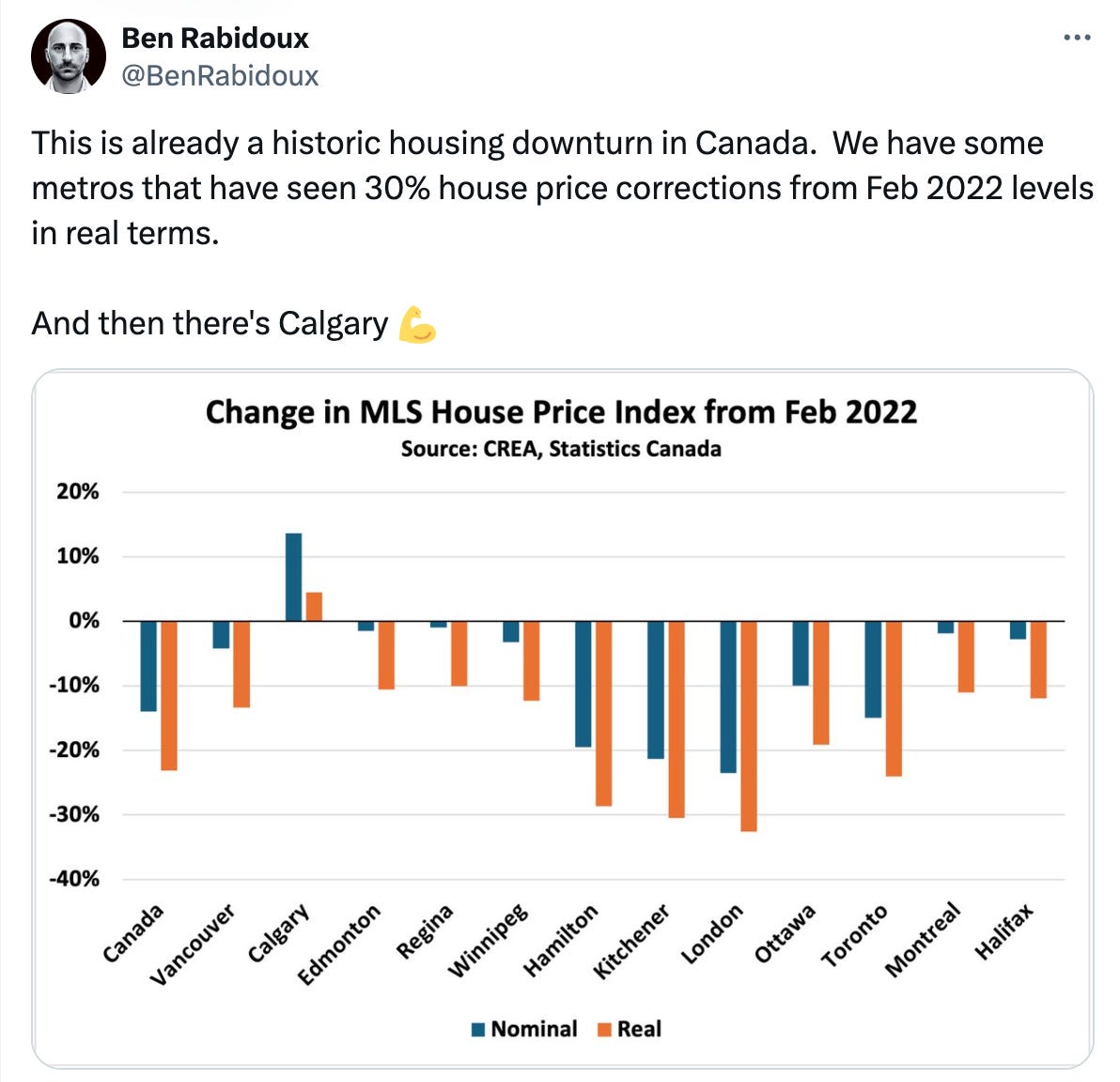
Memories are short. Calgary real estate prices went nowhere for more than a decade. Funny story, the first investment property I ever bought in Calgary was a detached house in the inner city. I bought it for $420,000 in 2019, which was the same price the previous owner had paid back in 2007. Twelve years of dead money!
Think that can’t happen in Vancouver and Toronto? It did in the 1990’s. A lost decade. In fact, adjusted for inflation, it took 22 years for Toronto real estate prices to recover in REAL terms after it peaked in 1989.
In Vancouver some segments are already enduring their own version of a lost decade. Detached houses on the west side of Vancouver peaked in 2016 and have bounced around since, ultimately no higher today than they were eight years ago.

The same story is playing out for condos downtown. They peaked in 2018 and have moved sideways for six years.
It’s rather interesting to see prime real estate in the heart of the city stagnate. Meanwhile, houses in Surrey, Langley, and Abbotsford have more than doubled since 2016, and i’m told they’re going higher once Macklem starts cutting.
If history is any guide, trees don’t grow to the sky and eventually other segments of the market will succumb to gravity too.
Suburban houses peaked in 2022 and have yet to fully recover. Remember, even a 100bps of rate cuts from the BoC brings the typical variable rate mortgage into the low 5’s which is exactly where fixed rates sit today. Will that be enough to avoid years of stagnation?
For many housing speculators a lost decade would be devastating, but on the flip side it would slowly allow incomes to catch up and housing affordability to gradually improve.

When you frame it that way, a lost decade doesn’t seem so bad.
Lots to digest, here. Isn't it a mug's game to pick random "decades" and show how things are "lost" when an alternate period within say five years of the chosen period might lead to entirely different results? Canadian media (and, generally, society) conflates housing "success" with how much someone has made if, say, they've inherited a parent's house that was purchased for $185,000 in 1984 (when interest rates were 5x what they are now) and have it on the market for $2.4 million 40 years later (wow, where DID that 40 years go?) Calgary - talk about a lost decade, hell, there's never been a collapse like that city went through following the implementation of the National Energy Program in the 80s. There was mass 'walking away' from mortgages that were worth far higher than the price of new, overbuilt eastern suburbs (indeed, in 2012, you might have called Riverside, California "the Calgary of California). If we wanted an equitable and just society in Canada, would we not have a housing market where people who work at full time jobs would have the opportunity to live close to (say, a half hour from where they live) to own their own homes? They might be single people owning studios, young families in townhouses, middle-aged families with an in-law suite, and the cost of housing would not strangle the typical family budget? There could be co-ops, equity co-ops, co-housing - lots of types. (Both forms of housing were tried in Kitsilano during the 80s and 90s). The amount of mental stress that thinking about housing puts on the typical relationship is beyond belief, which is of course the source of Millennial angst that we see in so many Canadian cities right now.
Didn’t the lost decade in the 1990s occur after a recession hit? We haven’t even hit that yet 🤷🏻♂️